
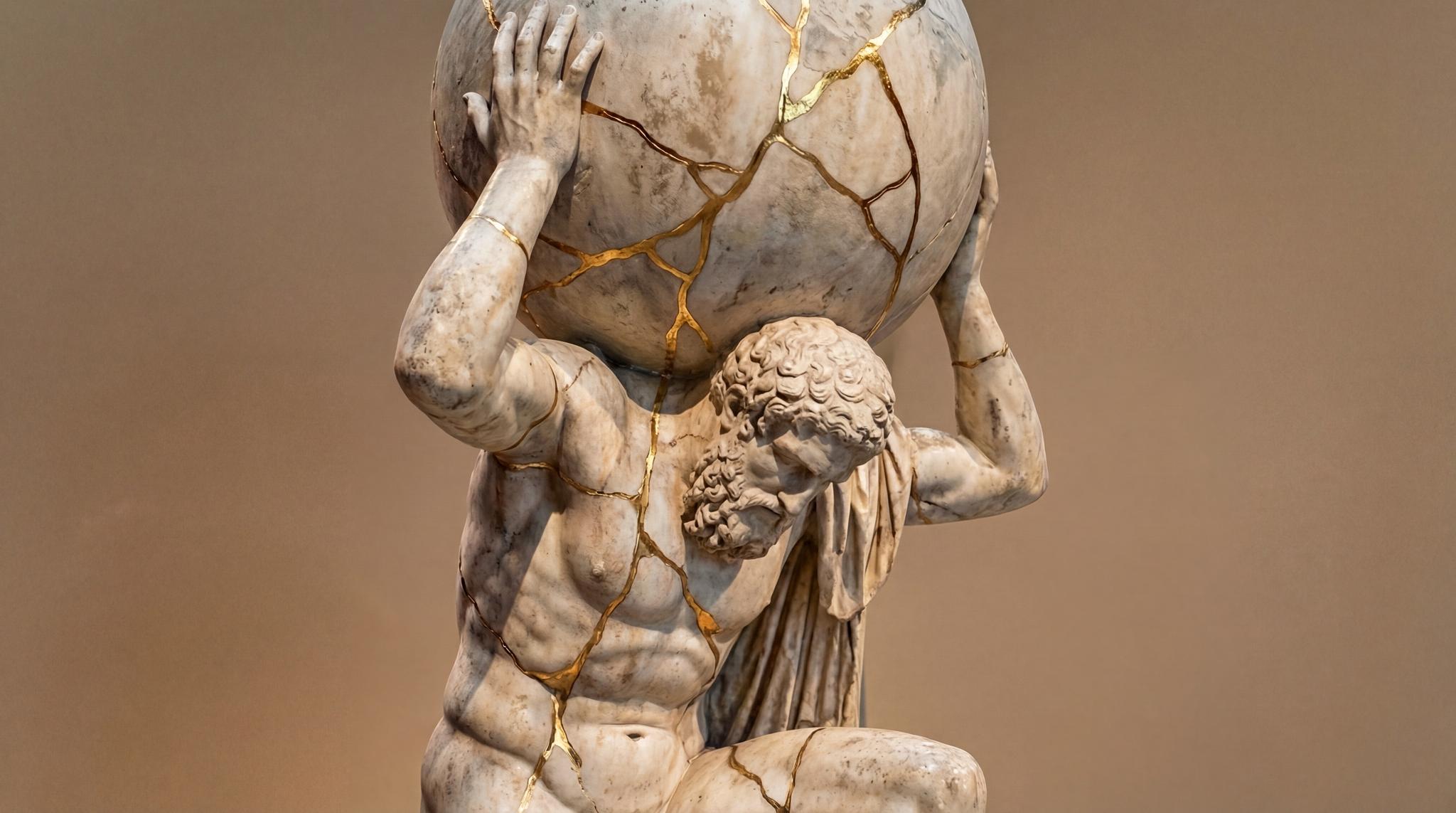
In traditional Japanese art, Kintsugi is the practice of repairing broken pottery with lacquer dusted or mixed with powdered gold, silver, or platinum. It treats breakage and repair as part of the history of an object, rather than something to disguise.
At LiveWisdom®, we view artificial intelligence* in a similar way. Our technology exists to repair, connect, and illuminate the gaps in our historical understanding, adding value to the whole. It is the binding agent that makes the Atlases of civilization accessible and engaging, while keeping the history itself as the substantive vessel.
*Our use of the term artificial intelligence is not an acknowledgement or endorsement of the idea that machines can think, feel, or possess consciousness. They cannot.
Artificial Intelligence
Artificial intelligence systems, including language models, are powerful computational tools capable of generating text and emulating human communication. As with any tool, their value depends on how they are used.
Much like other tools, language models should be used with caution and great responsibility. A hammer can be used to build a home, or as a weapon. It is the user’s intent that determines whether a tool will be used to advance human flourishing.
Yet unlike other tools, language models can easily replace one's own thinking and judgement. We often hear of the numerous potential economic, security, or societal dangers of “AI”. While these are all real threats, fundamentally, the greatest threat of “AI” is the appeal to permit it to replace one's own mind.
To the extent that we use it to augment our thinking, it will advance mankind; to the extent that we use it to replace our thinking, it will serve to its detriment.
For this reason, at LiveWisdom, human intelligence is behind everything we do. We recognize the limitations of AI and create a safe, authentic, engaging experience for our users. The only demand on our users is that they do not let anything replace the judgment of their own mind.
Human Oversight
AI systems can generate errors, incomplete information, or misleading outputs. For that reason, AI responses should always be approached critically and thoughtfully.
The intellectual framework, educational design, and historical interpretation behind LiveWisdom® are created and overseen by humans. AI tools are used within carefully designed systems intended to support meaningful educational experiences.
We implement technical and procedural safeguards intended to improve reliability and reduce misuse. Despite these safeguards, AI systems are not infallible. Users should treat AI-generated responses as tools for exploration rather than as final or authoritative conclusions.
Protection of User Data
Respect for user privacy is fundamental to how we build our technology.
LiveWisdom® does not use user data to train artificial intelligence models. Conversations, submissions, files, or other user-generated content on the platform are not used to train large language models unless users are clearly informed and explicitly consent. User data is processed only to provide and operate the service.
You can read more about this on our Privacy Policy.
Responsible Sourcing
LiveWisdom® is committed to responsible sourcing of the materials used in developing our educational systems.
We do not train our models on copyrighted or disputed materials without appropriate rights or permissions.
Our training and reference materials are limited to:
- public domain sources, or
- materials used with appropriate licenses or permissions
We believe education should be grounded in knowledge that is freely accessible and responsibly used.
Our Commitment
Artificial intelligence has the potential to expand access to knowledge on an unprecedented scale. But it will not do so on its own.
At LiveWisdom®, our commitments are simple:
- supremacy of human thinking
- respect for individual rights
- technology should advance human flourishing
The ancient Chinese philosopher Confucius put it best:
“He who learns but does not think is lost.”
At LiveWisdom®, we know education requires both.